Poker terminology plays a crucial role in helping players communicate, analyze, and execute strategies more efficiently at 99OK. Whether you are a beginner or an experienced player, mastering these terms is essential. In this article, you will discover practical ways to understand and use them confidently.
What is poker terminology and why it matters
Understanding poker terminology is essential for anyone who wants to follow the game and make informed decisions at the table. By mastering poker, players can communicate clearly and improve their overall performance at 99OK
- Terminology poker refers to the set of words and phrases used to describe actions, strategies, and situations in the game. These terms help players quickly understand what is happening during each round without confusion.
- It allows players to read the flow of the game more effectively and react with better timing. Knowing the right terms helps avoid misunderstandings that could lead to costly mistakes.
- Familiarity with key terms improves communication between players, especially in competitive environments. This creates a smoother and more professional gameplay experience.
- It also supports strategic thinking by helping players analyze positions, betting patterns, and opponent behavior. Clear understanding leads to more confident and calculated decisions.
- Learning these terms builds a strong foundation for both beginners and advanced players over time. With consistent practice at the platform, players can gradually develop sharper skills and deeper game awareness.
What is poker terminology and why it matters
Basic poker terminology every beginner should know
Learning the basics is the first step to understanding how poker works in real gameplay situations. By mastering poker terminology early, beginners can build confidence and make better decisions when playing at 99OK.
Common actions at the table
Understanding basic actions helps players follow the flow of each hand and respond correctly during gameplay.
- Fold means giving up your hand and losing any chips already placed in the pot. It is often used when the hand is too weak to continue.
- Call refers to matching the current bet made by another player to stay in the round. This action is common when players want to see the next card.
- Raise means increasing the current bet, putting pressure on opponents and potentially building a larger pot.
Key hand rankings
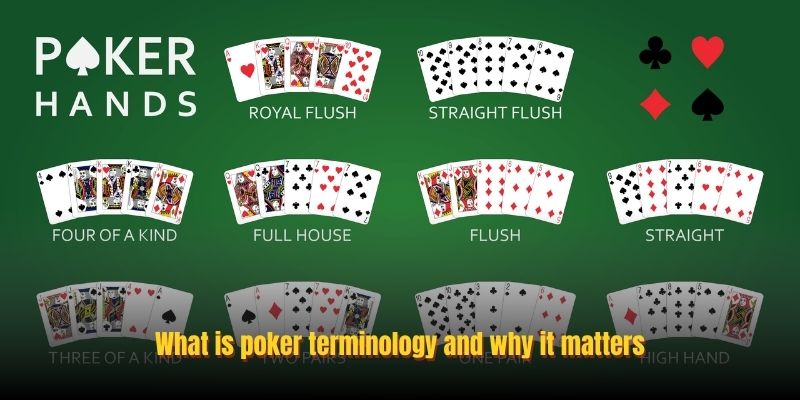
Knowing hand rankings is essential for determining winners and making strategic betting decisions in poker terminology.
- High card is the lowest ranking, used when no player has a stronger combination.
- Pair and two pair are common hands that can still win depending on the situation.
- Strong hands like straight, flush, and full house significantly increase winning chances.
Important table positions
Position plays a crucial role in how players act and make decisions during each round.
- Early position requires more cautious play since many players act after you.
- Middle position offers more flexibility but still requires balanced decision-making.
- Late position provides an advantage, allowing players to observe others before acting.
Basic betting structures
Understanding betting formats helps players adapt their strategies in different game types.
- Fixed limit games have predetermined betting amounts, making risk more controlled.
- No-limit games allow players to bet all their chips at any time, increasing intensity.
- Pot-limit games restrict bets based on the current pot size, balancing risk and reward.
Basic poker terminology every beginner should know
Common mistakes when learning poker terminology
Many beginners struggle with learning poker terminology due to misunderstanding concepts or applying them incorrectly in real situations. Recognizing these mistakes early will help players improve faster and build stronger skills at 99OK.
| Mistake | Explanation |
| Memorizing without understanding | Players often try to remember terms without knowing their actual meaning in gameplay. This leads to confusion when applying them in real situations. |
| Using terms incorrectly | Misusing terms like “bluff” or “raise” can result in poor decisions and misunderstandings at the table. Clear comprehension is essential for proper usage. |
| Ignoring context | Some terms change meaning depending on the situation, but beginners may apply them rigidly. Understanding context helps improve decision-making accuracy. |
| Learning too many terms at once | Trying to absorb everything quickly can overwhelm new players and reduce retention. A step-by-step approach is more effective for long-term learning. |
| Not practicing in real games | Without applying knowledge in actual gameplay, players may forget terms or fail to use them correctly. Practice at the platform helps reinforce learning naturally. |
Advanced terminology poker used by experienced players
As players gain more experience, understanding deeper concepts becomes essential for improving strategy and consistency. Mastering advanced poker terminology allows skilled players to analyze situations more precisely and gain an edge at the platform.
Bluffing and semi-bluff strategies
Bluffing is a key concept that requires both timing and understanding of game flow to be effective.
- A bluff means betting with a weak hand to force opponents to fold stronger hands.
- A semi-bluff involves betting with a drawing hand that can improve later.
- These strategies require confidence and careful observation of opponents.
Reading opponents and table dynamics
Experienced players use advanced poker terminology to describe how they interpret opponents’ behavior and decision patterns.
- Terms like “read” refer to predicting an opponent’s hand based on their actions and betting style.
- “Range” describes the possible hands an opponent might have in a given situation.
- Observing patterns helps players make more informed and strategic decisions.
Advanced terminology poker used by experienced players
Pot control and value betting
Managing the pot size is crucial for maximizing profits and minimizing losses in complex situations.
- Pot control refers to keeping the pot small when holding a marginal hand.
- Value betting means placing bets to extract maximum chips from weaker hands.
- These techniques help balance risk and reward effectively.
Implied odds and expected value
Understanding long-term profitability is a key difference between beginners and advanced players.
- Implied odds estimate future winnings if a drawing hand improves.
- Expected value (EV) measures whether a decision is profitable over time.
- These concepts guide players toward mathematically sound decisions.
Conclusion
Mastering poker terminology is a key step toward becoming a more confident and strategic player. When you understand the language of the game, every decision becomes clearer and more calculated. By practicing consistently at Bắn Cá 99OK, you can steadily improve your skills and overall performance.