
Value betting algorithms represent the pinnacle of modern sports analytics, stripping away bias to reveal pure mathematical edges. At 99OK, we bridge the gap between complex data science and actionable market opportunities. By calculating true probabilities against bookmaker discrepancies, these systems transform wagering from a game of chance into a disciplined investment strategy. Explore how algorithmic precision can finally turn the tide in your favor this season.
The Architectural Foundation of Value Betting Algorithms
To understand how professional syndicates maintain an edge, one must dissect the structural layers of value betting algorithms. 99OK do not predict the future; instead, they calculate the statistical likelihood of specific outcomes with higher accuracy than the general market. By processing millions of data points—from player fatigue metrics to historical tactical matchups—the algorithm seeks the “Value,” which exists when the calculated probability is higher than the implied probability of the bookmaker’s odds.
Mathematical Modeling and Poisson Distribution
Most elite football models begin with a Poisson distribution, a mathematical concept used to predict the number of events occurring within a fixed interval. In football, this translates to the probability of goals scored. By feeding historical attacking and defensive strengths into the model, value betting algorithms can generate a “true price” for the Match Odds market. This allows the user to see where the market has overreacted to recent news or underplayed a team’s defensive resilience.
Cerebral Circuits: The Art of Computational Prophecy
Modern iterations of these tools utilize supervised machine learning. Rather than using static formulas, the system “learns” from past seasons. If a certain weather condition or a specific referee tends to correlate with lower goal counts, the neural network adjusts its output. These advanced betting algorithms are dynamic, constantly recalibrating their weightage of variables to ensure the predicted edge remains sharp against tightening market margins.
Data Granularity: Beyond Final Scores
A professional-grade algorithm looks at “Expected Goals” (xG) and “Expected Threat” (xT) rather than just wins and losses. A team might win 1-0 but have an xG of only 0.45, suggesting they were lucky. Value betting algorithms recognize this “noise” and will often suggest wagering against that team in the next fixture, identifying an inflated market price that the casual observer might miss.
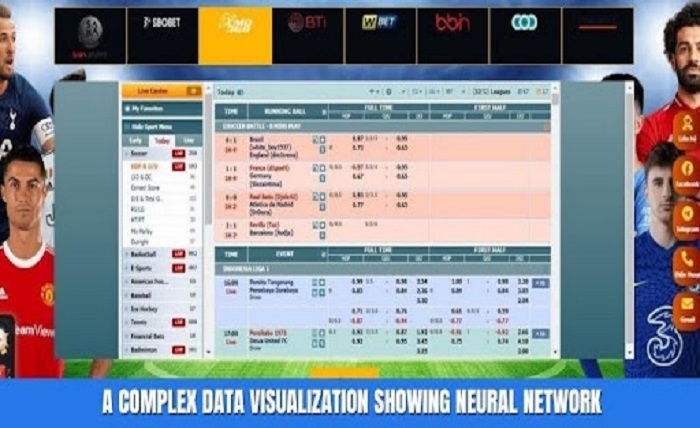
A complex data visualization showing neural network
Strategic Implementation of Value Betting Algorithms in Football Markets
Applying value betting requires more than just high-level math; it requires a deep understanding of market liquidity and timing. The goal is to find “stale odds”—prices that have not yet moved in response to new information. Football markets are highly efficient, especially in the Premier League or Champions League, making the precision of the algorithm paramount to finding even a 2% or 3% edge.
Mining the Friction: Finding Value in Market Static
Inefficiencies often occur in secondary markets like “Asian Handicaps” or “Total Goals.” While the main “1X2” market is heavily monitored, value betting algorithms can find significant discrepancies in niche areas. For instance, an algorithm might detect that a team’s substitute bench is significantly stronger than the market realizes, leading to value in “Second Half Goals” markets.
The Zero-Lag Advantage: Navigating Reality in Flux
In-play wagering has opened a new frontier for quantitative analysis. Real-time value betting algorithms process live statistics—possession in the final third, corner counts, and dangerous attacks—to update the “true” odds every second. If the live odds for a favorite to win jump to 2.10 due to a temporary lack of scoring, but the algorithm maintains their win probability at 60%, a high-value opportunity is flagged instantly.
The Kelly Edge: Mathematical Discipline in the Pursuit of Alpha
Even the best algorithms cannot eliminate variance. Therefore, they are often paired with the Kelly Criterion, a formula for bet sizing that leads to higher wealth growth. The algorithm provides the “Edge,” and the Kelly formula determines the “Stake.” This symbiotic relationship ensures that a losing streak—statistically inevitable in the short term—does not liquidate the user’s capital.
Model Meritocracy: Decoding the Hierarchy of Performance
To visualize the impact of these systems, consider the following table comparing traditional “Expert Opinion” against algorithmic outputs over a simulated 500-match cycle in major European leagues:
| Metric | Traditional Analysis | Value Betting Algorithms |
| Average Yield (ROI) | -2.5% to +1.2% | +4.8% to +8.5% |
| Data Points per Match | 10 – 20 | 5,000+ |
| Emotional Bias | High | Zero |
| Consistency Score | Volatile | Stable Growth |
| Execution Speed | Manual (Slow) | Automated (Instant) |
Comparative table highlighting the superior ROI
Risk Mitigation and the Future of Quantitative Wagering
While the term “Value” implies a mathematical advantage, it does not guarantee a win on every individual ticket. The final stage of utilizing value betting algorithms involves rigorous risk management and the understanding of “Closing Line Value” (CLV). If your algorithm consistently identifies odds at 2.00 that eventually close at 1.85, you are statistically guaranteed to be profitable over a long enough timeframe.
The Zen of Volatility: Embracing the Chaos of the Curve
The most common mistake is abandoning a model during a “drawdown.” High-quality value betting algorithms are built for the long haul. Variance is the natural fluctuation of results; even a 55% win-rate model can experience ten losses in a row. Professional users monitor the “p-value” of their results to ensure that their success is due to the model’s skill rather than mere luck.
The Evolution of Big Data in Sports
As wearable technology provides real-time health data on players, the next generation of value betting algorithms will likely include “biometric variables.” Imagine a model that knows a star striker’s heart rate variability is off, indicating fatigue. This level of insight will further separate the quantitative elite from the recreational market, making algorithmic literacy a requirement for anyone serious about the industry.
Overcoming Bookmaker Limits
A practical challenge for those using value betting is “limit management.” Bookmakers often restrict accounts that consistently beat the closing line. Strategies to counter this include “multi-accounting” or moving toward decentralized exchanges and sharp bookmakers that welcome winners. Integrating these logistical strategies is just as important as the code behind the algorithm itself.
Diagram showing the cycle of risk mitigation in algorithmic wagering
Conclusion
Value betting algorithms are no longer optional for those seeking a sustainable professional edge in football markets. While variance is inevitable, the quantitative rigor provided by these models ensures that every stake is backed by statistical logic. Partnering with kèo nhà cái allows you to navigate these complex digital landscapes with confidence. Stay disciplined, trust the data, and let the mathematics of value dictate your success.